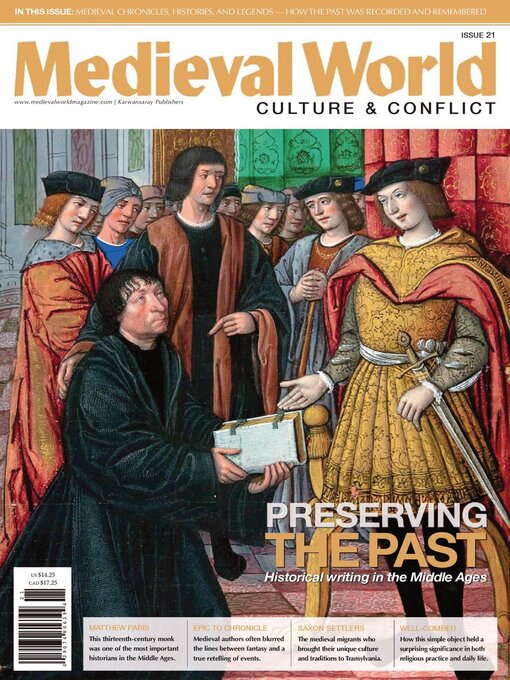
 Issue 21 - 2026
 Issue 20 - 2025
 Issue 19 - 2025
 Issue 18 - 2025
 Issue 17 - 2025
 Issue 16 - 2025
 Issue 15 - 2024
 Issue 14 - 2024
 Issue 13 - 2024
 Issue 12 - 2024
 Issue 11 - 2024
 Issue 10 - 2024
 Issue 9 - 2023
 Issue 8 - 2023
 Issue 7 - 2023
 Issue 6 - 2023
 Issue 5 - 2023
Medieval World: Culture & Conflict picks up where its sister magazines – Ancient Warfare and Ancient History – leave off. The publication features the rich history and material culture of the Middle Ages – broadly conceived geographically and temporally – expanding on the contents of the popular Medieval Warfare magazine. Through well-researched and lavishly illustrated articles, this accessible publication brings to light cultural activities in local and global contexts, historical figures and events, as well as political, religious, economic, and artistic facets of the Middle Ages..
Medieval World Culture & Conflict Magazine
Editorial
MARGINALIA
Medieval shoes
DEFENDING THE SONG DYNASTY • After the collapse of China's golden age in the Tang Dynasty (618–907), China fell into a period of disunity and internal division. It was not until 960 that Emperor Taizu reunited China's lands and ushered in another golden era, called the Song Dynasty. Unprecedented achievements in science, technology, commerce, and industry followed, making Song China the most advanced civilization of the medieval world.
Military innovations
LITURGICAL OR KNOT? • On the surface, medieval combs might not sound like the most compelling of topics. But as is usually the case with every day, innocuous objects, combs can reveal various ways of understanding the medieval worldview that are not typically recorded in manuscripts or written in kings’ decrees.
CRAFTING A REPUTATION • Today, we know little about individual artists from the Middle Ages. Surviving artworks offer insight into their practices and techniques, sometimes even their training. Textual sources can also be informative. Manuals, inscriptions, and contracts reveal aspects of the activities and identities of medieval artists. Although artistic individuality was rarely acknowledged, excellence in a given craft could be promoted in other ways.
Manuals
WRITING HISTORY IN THE MIDDLE AGES • In the Middle Ages, history was a way to understand one's place in the world and relationship to power, both earthly and divine. History was not just a record of facts, but part of a more meaningful story connected to religion, politics, and daily life.
NOBLE DEEDS AND TROPES • Warfare took up a large part of the corpus of medieval writing, whether the report-age of chronicle or annal, the storytelling of epics and romance, or the reminiscences of biography or autobiography. How did writers construct their narratives, and what did they seek to convey to their audiences about the experience of battle?
MATTHEW PARIS • Matthew Paris (d. 1259) is one of only a handful of medieval writers of history whose work has been read and consulted ever since his lifetime. He stands with Bede of Monkwearmouth, author of the Ecclesiastical History of the English People (d. 735), Einhard, biographer of Charlemagne (d. 840), and Jean Froissart (d. 1405), chronicler of the Hundred Years War, as an historian whose knowledge of the past and vision for how to present it to readers exerted a powerful influence both during the Middle Ages and long after.
SEEING IS BELIEVING? • Across ancient Greece, medieval Europe, and the medieval Arab world, historians and travelers increasingly positioned themselves within their own narratives. What began as autopsia, or knowledge grounded in direct observation, gradually expanded into forms of self-narration in which the author's experiences, movements, and judgments became essential to the history being conveyed.
FROM EPIC TO CHRONICLE • When we think of medieval chronicles, we often imagine a simple record of events, an attempt to reflect ‘true’ history. Yet, behind the recording of deeds lies the art of storytelling. French vernacular chroniclers were not merely logging the incidents of their day; in their writing they...